In this guide
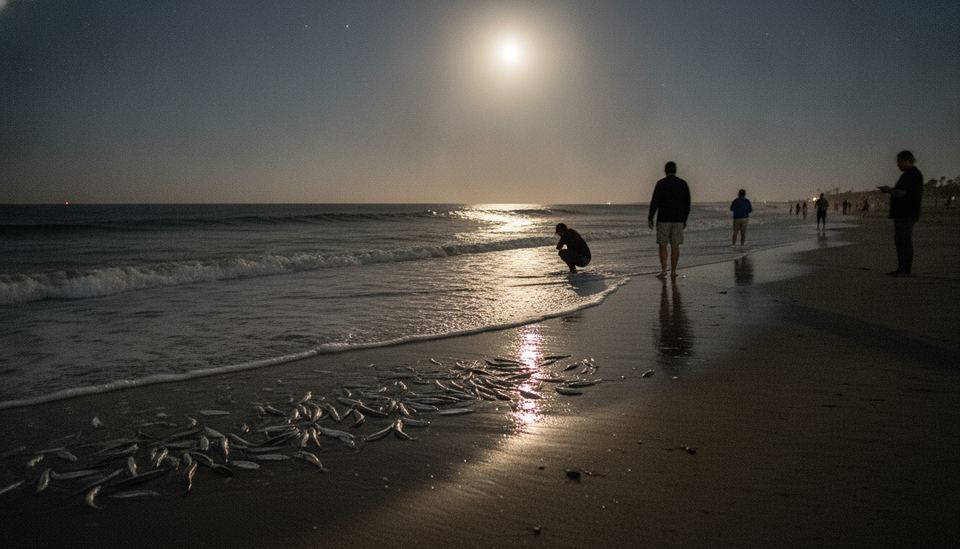
A grunion run is the few hours on a spring or summer night when thousands of small, silvery fish surf onto a sandy beach, lay and fertilize eggs in the wet sand, and wriggle back into the waves. In San Diego County, runs happen from late winter or early spring through late summer, on the nights right after a full or new moon, starting shortly after high tide.
To see one, you need three things: the expected-run schedule from the California Department of Fish and Wildlife (CDFW), a wide sandy beach with a gentle slope, and patience. Runs are never guaranteed. Some nights the beach fills with fish, other nights you see three scouts and go home.
What a grunion run is
California grunion are small fish found along the Southern California and northern Baja California coast. What makes them unusual is that they spawn out of the water. According to CDFW's grunion page, a female rides a wave up the beach, digs tail-first into the wet sand and lays her eggs, while one or more males curl around her to fertilize them. Then they all catch the next wave back out.
The eggs stay buried in the sand above the reach of the following tides. CDFW explains that they hatch when the next series of high tides washes over them and stirs the sand, about ten days later. The timing is the whole trick: the fish spawn just after the peak tide, so the next waves do not dig their eggs out too early.
Why the moon matters
The highest tides of each month come with the full and new moons. CDFW says runs take place for several consecutive nights beginning on the nights of the full and new moons, after the high tide, and that each run lasts from one to a few hours. So twice a month, during the season, you get a short window of possible nights.
When grunion run
The season
CDFW describes the spawning season as running from late February or early March to August or early September, varying a little from year to year. The busiest months for spawning are spring and early summer.
Reading the CDFW schedule
Each year, CDFW publishes a table of expected runs with dates and two-hour windows. Those predictions are calculated for Cabrillo Beach in San Pedro. CDFW notes that runs in San Diego come about five minutes earlier and runs in Santa Barbara about 25 minutes later, so the adjustment for San Diego is small.
Arrive before the start of the window. Fish often show up gradually: a few scouts first, then, if conditions suit them, a larger wave of spawners.
| Month | What you can do | Notes |
|---|---|---|
| March | Watch; catch by hand with a license (16+) | Early-season runs can be small |
| April | Watch only | Closed season: no touching, no take |
| May | Watch only | Closed season, often busy runs |
| June | Watch only | Closed season |
| July | Watch; catch by hand with a license (16+) | Warm nights, crowded beaches |
| August | Watch; catch by hand with a license (16+) | Season winds down |
Always check CDFW's current page for the year's dates and rules before you go; the closed season and run predictions are set by the state.
Where to watch in San Diego County
Grunion need fairly wide beaches of packed sand with a gentle slope. Rocky shores, steep cobble beaches and narrow strips below bluffs are poor bets.
CDFW does not point to a single best beach and notes that runs can happen on any suitable sandy stretch along the coast. Local reports have described runs at many county beaches, including Coronado, Imperial Beach, Pacific Beach, Mission Beach, La Jolla Shores, Del Mar and Encinitas, and in Oceanside farther north.
A few things improve your odds:
- Pick a long, sandy beach with dim lighting nearby. Bright piers, parking lots and boardwalk lights can keep fish away.
- Choose a spot where you can walk along the waterline, since fish may come up a few hundred yards from where you are standing.
- Ask lifeguards. CDFW suggests calling local lifeguards to learn whether runs have been seen on a given beach.
If you want to know a beach in daylight first, our Coronado Beach guide covers access and parking, and our Pacific Beach guide explains what that stretch is like after dark. For a broader comparison, see how to pick the right San Diego beach.
The rules: watch, touch, catch
The rules come from the state and they change with the calendar.
Closed season: April through June
CDFW keeps April, May and June as a closed season to protect grunion during peak spawning. In those months you can watch from the beach, but you may not handle, collect or take any grunion. That includes picking one up for a photo.
Open months
Outside the closed season, anyone 16 or older needs a valid California sport fishing license to take grunion. Fish may be caught with the hands only, so nets and other gear are not allowed. CDFW also sets a daily bag limit for grunion, listed on its grunion page and in the state's ocean sport fishing regulations. Read the current regulations before you take a single fish; they are the reference, not this guide.
Watching without harming them
Most people come to watch, not to catch, and that is easy to do responsibly. Stay above the wet sand where fish are landing, let them come and go, and don't walk through a cluster of spawning fish. Keep dogs leashed and away from the waterline. Don't shine strong lights on the sand. And don't dig where fish have spawned, since the eggs are just below the surface.
Helping science: the Grunion Greeters
Volunteer observers called Grunion Greeters report what they see during runs, using a simple rating scale, so researchers can track how grunion are doing beach by beach. The program is described on grunion.org, which also lists training opportunities. If you plan to watch several runs a season, reporting takes a few minutes and turns a nice night out into useful data.
Making the night work
Grunion runs happen late. In summer, the night high tides that matter often fall late in the evening, which means your watch can stretch well past bedtime for kids. A beach blanket, a jacket and snacks make waiting easier. Expect sand, damp feet and some nights with no fish at all.
Coastal clouds can roll in at night, especially in late spring and early summer. They don't stop the fish, but they make the beach colder and darker. Check beach rules before you go: some San Diego beaches limit fires, glass and alcohol, and many parking lots have posted closing hours.
If you enjoy wildlife watching on the shoreline, our guide to tide pools in San Diego covers another way to see marine life up close, by daylight and at low tide. For more trips like this, browse the rest of our Beaches & Outdoors section.
True or false?
Grunion facts: true or false?
Six statements taken from this guide. Pick true or false, then read the explanation.
Grunion runs happen on the nights after full and new moons, following the high tide.
It's covered in the section Why the moon matters
CDFW says runs take place over several nights beginning with the full and new moons, after high tide.The CDFW schedule is calculated for San Diego, so no adjustment is needed here.
It's covered in the section Reading the CDFW schedule
Predictions are calculated for Cabrillo Beach in San Pedro; runs in San Diego come about five minutes earlier.In May you can pick up a grunion for a quick photo as long as you put it back.
It's covered in the section Closed season: April through June
April, May and June are closed season: watching is fine, but handling or taking grunion is not allowed.In open months, anyone 16 or older needs a California fishing license to take grunion, by hand only.
It's covered in the section Open months
A sport fishing license is required from age 16, and grunion may only be caught with the hands.Steep, rocky beaches are the best places to wait for a run.
It's covered in the section Where to watch in San Diego County
Grunion need wide beaches of packed sand with a gentle slope; rocky or steep cobble shores are poor bets.Bright flashlights on the sand can keep grunion from coming ashore.
It's covered in the section Watching without harming them
Strong lights can scare fish away, so keep lights dim and pointed down.
Next up: Planning a late-spring grunion night? Learn why San Diego beaches are often cloudy in May and June.
Questions readers ask
When do grunion run in San Diego?
From late February or March through August or early September, on the nights after the full and new moons. Each run follows a high tide and can last from one to a few hours.
Can you touch grunion during a run?
Not in April, May or June, which CDFW keeps as a closed season to protect peak spawning. In open months, people 16 and older with a fishing license may catch them by hand only.
Which San Diego beaches have grunion runs?
Grunion favor wide, sandy, gently sloping beaches. Runs have been reported at many county beaches, including Coronado, Pacific Beach, La Jolla Shores and Del Mar, but no beach is guaranteed on a given night.
How do I know if a run will happen?
Use the expected-run schedule published by the California Department of Fish and Wildlife, subtract about five minutes for San Diego, and arrive early. CDFW suggests calling local lifeguards to ask where runs have been seen.