In this guide
Whale watching in San Diego follows two seasons. From about mid-December into spring, Pacific gray whales migrate along the coast between Alaska and the lagoons of Baja California, and you can often spot them from shore, with the southbound peak around mid-January. From late spring through fall, blue whales feed offshore, and you usually need a boat to see them. Pick your season first, then decide between a lookout on the cliffs and a trip on the water.
The rest of this guide covers what to expect in each season, the best places on land, how to choose a boat trip, and the distance rules that protect the whales. For more coastal trips and hikes, see our Beaches & Outdoors section.
Gray whale season: December into spring
Gray whales are the headline act. The National Park Service at Cabrillo National Monument calls them the largest marine mammals you'll see from the Point Loma area. Each fall the eastern North Pacific population leaves its summer feeding grounds in the far north and heads south. NOAA Fisheries describes them spending the winter off Baja California, where calves are born in shallow lagoons and bays from early January to mid-February. A NOAA Southwest Fisheries Science Center document puts the whole round trip at roughly 15,000 to 20,000 kilometers (about 9,300 to 12,400 miles).
San Diego sits right on that route, so the whales pass twice:
Southbound (December to February)
Southbound whales are moving with purpose. They travel fairly close to shore, and the park service has long pointed to mid-January as the peak off Point Loma. On a good day you may see several spouts in an hour.
Northbound (February into May)
On the way back north, from mid-February to May according to NOAA, the group includes mothers traveling with this year's calves. This is a good time for patient watchers on land, because a mother and calf resting near shore can stay in view for a while.
Blue whales and the summer season
Blue whales are a different story. They come to Southern California to feed on krill, which gathers in summer and fall when cold, nutrient-rich water rises along the coast. A 2024 study by Scripps-affiliated researchers, using underwater recorders, tracked blue whales arriving off Southern California in late spring, staying through fall and leaving in early winter. Earlier satellite-tagging work published in Marine Mammal Science in 1999 described the same pattern: a late-summer feeding season, then a southward migration in fall.
Blue whales feed farther out than gray whales migrate, so a boat trip is the realistic way to see them. Sightings vary a lot from year to year with ocean conditions, and nobody can promise one on a given day.
What else you might see
Whales get the attention, but they aren't the only marine mammals here. The park service's marine mammals page for Cabrillo notes that dolphins, seals and sea lions are often seen from the cliffs. If you're on a boat, a pod of dolphins riding the bow wave is a common highlight. If you want a reliable sea lion fix on land, La Jolla Cove is the place, with its own rules for keeping your distance.
| Season | Main species | Best way to watch | Where |
|---|---|---|---|
| Mid-December to February | Gray whales, southbound | Shore or boat | Point Loma, Torrey Pines bluffs, boat trips |
| Mid-February to May | Gray whales, northbound, mothers with calves | Shore or boat | Same spots, closer to shore |
| Late spring to fall | Blue whales | Boat | Offshore |
| Year-round | Dolphins, sea lions, seals | Shore or boat | Cliffs, coves, bay and offshore |
Best places to watch from shore
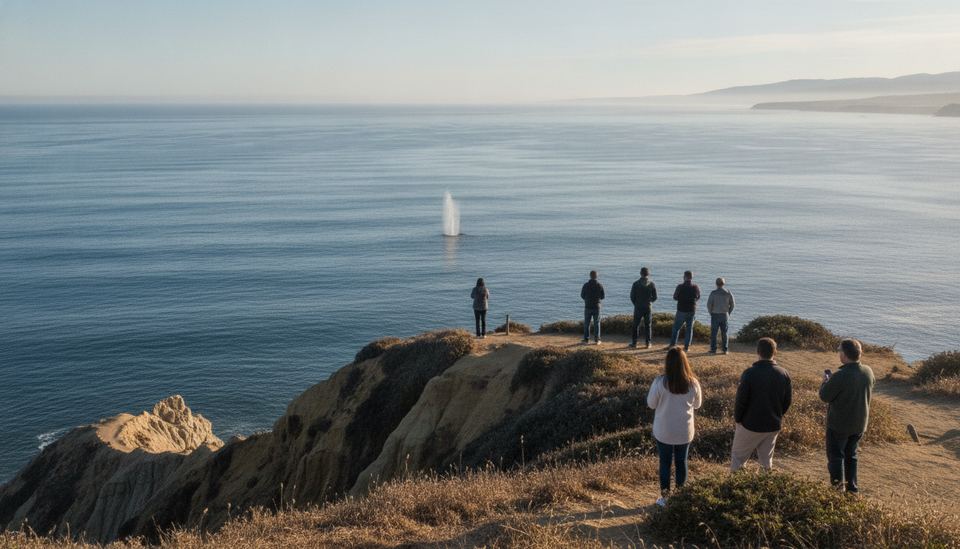
You don't need a ticket to see a gray whale. You need height, a clear morning and patience.
Cabrillo National Monument
At the tip of Point Loma, Cabrillo has a Kelp Forest and Whale Watch Overlook facing the open Pacific. The heights around the overlook and the Old Point Loma Lighthouse are, in the park service's words, among the best viewing spots. The park also holds a Whale Watch Weekend each year in late January or early February. Cabrillo is a national park site with an entrance fee, so check the NPS page for current fees and hours before you go.
Torrey Pines State Natural Reserve
The bluffs at Torrey Pines rise high above the beach, which makes them a great platform for spotting spouts. California State Parks lists day-use hours from 7 a.m. to sunset. Short trails like the Guy Fleming loop have ocean overlooks. Stay on the trails; the sandstone edges crumble.
Sunset Cliffs and other bluffs
Any high point near the water works in season. Sunset Cliffs in Point Loma is popular, but the bluff edges are unstable, so watch from well back and from the marked paths. Our Sunset Cliffs guide covers where to stand.
Choosing a boat trip
Boat trips leave from San Diego Bay, Mission Bay and harbors in North County. Some operators run all year; others focus on gray whale season. Since sightings are never guaranteed, read the operator's policy on what happens if no whales show up. Some offer a return pass.
A few things to ask before you book:
- How long is the trip, and how far offshore does it go? Blue whale trips usually head farther out.
- Is there a naturalist on board? A good one makes the trip much more interesting.
- Is there covered seating and a restroom?
- What's the plan if seas are rough?
Bring layers even in summer. It's colder on the water than on the beach, especially when the marine layer hangs around in the morning. If you're prone to seasickness, talk to a pharmacist or your doctor ahead of time rather than guessing on the dock.
Keeping your distance
Whales are protected under the federal Marine Mammal Protection Act. NOAA's Be Whale Wise guidelines for the West Coast ask everyone on the water to stay at least 100 yards (about 90 meters) from whales, roughly the length of a football field. Getting too close can stress the animals, and NOAA warns it may break federal law. The rule applies to kayaks, paddleboards and private boats as much as to tour vessels.
If you see a whale in trouble, such as one tangled in fishing gear, don't try to help it yourself. Note the location and report it to NOAA. The Be Whale Wise page also lists NOAA's enforcement hotline for reporting harassment.
Planning around the weather
Winter in San Diego brings clear, cool mornings between storms, which happen to be prime whale-spotting conditions. After a storm, seas can stay rough for a day or two, and boat trips may cancel. In late spring and early summer, a thick marine layer can sit on the coast until midday. It can make spotting harder from the cliffs and the water feel colder.
For land watching, go on a calm, clear morning in January or March. For a shot at blue whales, book a boat trip in summer and accept that the ocean decides. And if you also enjoy watching ships rather than whales, our guide to the best spots to watch ships on San Diego Bay covers the calmer side of the water.
True or false?
True or false: San Diego whale season
Five statements. Tap true or false, then see what to reread.
Mid-January is the peak of the southbound gray whale migration off Point Loma.
It's covered in the section Southbound (December to February)
The National Park Service at Cabrillo National Monument points to mid-January as the peak.Blue whales are easiest to see from shore in December.
It's covered in the section Blue whales and the summer season
Blue whales feed offshore from late spring through fall, so a boat trip is the realistic way to see them.NOAA asks boats, kayaks and paddleboards to stay at least 100 yards from whales.
It's covered in the section Keeping your distance
NOAA's Be Whale Wise guidelines set 100 yards, about the length of a football field, for everyone on the water.Gray whale calves are born in the waters off San Diego.
It's covered in the section Gray whale season: December into spring
NOAA describes calves being born in the shallow lagoons and bays of Baja California, from early January to mid-February.Calm, clear mornings are the best time to spot spouts from land.
It's covered in the section Best places to watch from shore
Morning wind is usually lighter and the water flatter, which makes the mist of a spout easier to see.If you see a whale tangled in fishing gear, you should paddle out and free it yourself.
It's covered in the section Keeping your distance
Don't try to help it yourself. Note the location and report it to NOAA.
Next up: Staying on the bay? Here's how to plan a visit to the USS Midway Museum.
Questions readers ask
When is whale watching season in San Diego?
Gray whale season runs from about mid-December into spring, with the southbound peak around mid-January and northbound whales passing from mid-February into May. Blue whales are mostly a summer and fall sight, from late spring into early winter.
Can you see whales from shore in San Diego?
Yes, mostly gray whales in winter. Cabrillo National Monument on Point Loma has a whale overlook, and the bluffs at Torrey Pines State Natural Reserve are another good lookout. Binoculars help a lot.
How close can you get to a whale in San Diego?
NOAA's Be Whale Wise guidelines ask boats, kayaks and paddleboards to stay at least 100 yards away, about the length of a football field. Whales are protected under the federal Marine Mammal Protection Act.
What's the best month to see gray whales in San Diego?
January. The National Park Service at Cabrillo National Monument describes mid-January as the peak of the southbound migration.